If you're eating a lot of protein — multiple shakes a day, protein bars as snacks, maybe some protein crisps between meals — you're probably paying close attention to your protein and calorie numbers. But there's a third number that most high-protein dieters quietly ignore, and it tends to bite back: fiber.
The recommended daily fiber intake is 25–30 g for most adults. The average American gets about 15 g. Now replace a few regular meals and snacks with protein products — most of which contain zero fiber — and that number drops further. The result is a diet that's optimised for one macro and accidentally deficient in another.
This isn't a theoretical problem. It shows up in our data. We looked at over 700 products in our catalogue, and the fiber gap between product formats is staggering.
MacroXray may earn a commission on some links in this article at no extra cost to you. Full disclosure.
The fiber gap is a format problem
Not all protein products are created equal when it comes to fiber. The average fiber content varies dramatically depending on the product format — and most people don't realise how stark the divide is.
Bars average around 12 g of fiber per 100 g. Sweet snacks sit at about 11 g. Crisps come in at roughly 7 g. But protein powders — the most commonly consumed protein supplement — average just 3 g per 100 g. And RTD shakes? Practically zero.
That means if your protein routine revolves around shakes and powders — as it does for most people — you're getting almost no fiber from those calories. Every shake you drink is a missed fiber opportunity that you'll need to make up somewhere else in your diet.
The format you choose is, quietly, a fiber decision.
The products that solve both problems
A handful of products deliver genuinely high protein and high fiber — the unicorns of the catalogue. These are the products that don't force you to choose between the two.
Julian Bakery: the fiber specialists
If there's one brand that owns the fiber-plus-protein space, it's Julian Bakery. Their products consistently rank among the highest-fiber items in our catalogue — and the numbers are genuinely remarkable.
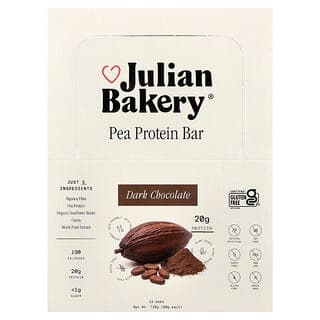
Rank #2 bar overall — 31.67 g fiber per 100 g makes it the highest-fiber bar in the catalogue.
Julian Bakery Pea Protein Bar (Dark Chocolate) holds rank #2 out of over 200 protein bars with an XRay Score of 90.7. It delivers 33.33 g of protein per 100 g alongside 31.67 g of fiber — that fiber figure is nearly triple the bar-category average. The product earns its high XRay Score specifically because fiber is one of the five scoring dimensions, and this bar dominates it.
Their ProGranola Clusters (Espresso) push even further: 40 g of fiber per 100 g with 33.33 g of protein, earning an XRay Score of 86.5 among sweet snacks. The Vegan Vanilla and Chocolate variants deliver similar fiber numbers. If you're specifically looking for a fiber-first protein snack, Julian Bakery is the short answer.
Why Quest bars quietly rank so well
You might wonder why Quest bars occupy so many top spots in our rankings. Flavor plays a role — as we covered in our nostalgic flavors piece — but fiber is the less obvious reason.
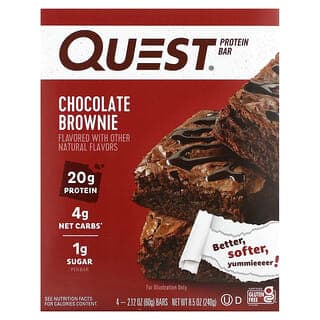
Rank #3 overall — 25 g fiber per 100 g, a number most people don't associate with a brownie-flavored bar.
Quest Chocolate Brownie delivers 25 g of fiber per 100 g — double the bar-category average. Quest S'Mores, the #1 bar overall, hits 21.67 g. Quest's formulations lean heavily on soluble corn fiber and isomalto-oligosaccharides, which pushes their fiber numbers well above competitors. That fiber content is a meaningful part of why they rank so high in our system — it's not just protein efficiency carrying the score.
This is worth understanding when you compare products: two bars with identical protein per 100 g can rank very differently if one has 20+ g of fiber and the other has 2 g. Fiber isn't a bonus — it's a full scoring dimension, and it separates tiers.
The pretzel surprise
Savory snacks aren't usually where you'd look for fiber, but Crisp Power Protein Pretzels break that expectation. The Sea Salt variant delivers 56.44 g of protein per 100 g and 21.16 g of fiber, earning rank #4 among savoury snacks with an XRay Score of 84.6. That's a pretzel outperforming most protein bars on both protein and fiber.
The format matters here. Pretzels use dough — flour, baking, structure — which naturally carries more fiber than a whey isolate powder dissolved in water. It's another example of how whole-food-adjacent formats tend to outperform liquid-first formats on fiber.
What about powders?
Here's the uncomfortable truth: most protein powders have zero fiber. The top-ranked powders in our catalogue — collagen, whey isolate, plant blends — are engineered for protein density and leanness. Fiber isn't part of that equation.
The exception is Julian Bakery Pegan Thin (Triple Chocolate): 18.18 g of fiber per 100 g alongside 45.45 g of protein. It's the only powder in the catalogue with meaningful fiber. But its XRay Score is 24.6 — the fiber is offset by lower protein efficiency and higher calories. It's a niche product for someone who specifically wants a fibrous shake, not a general recommendation.
The practical takeaway: don't expect your protein powder to solve your fiber problem. Get your fiber from bars, snacks, and whole foods — and treat powder as a pure protein delivery mechanism.
How to audit your own fiber intake
If you're on a high-protein diet, a quick self-audit is worth doing. Add up the fiber in your protein products for a typical day. If you're relying on powders and shakes, that number is probably close to zero — which means your whole-food meals need to carry the full 25–30 g burden alone.
The fix isn't complicated: swap one daily shake for a high-fiber bar, or add a handful of ProGranola clusters as a snack. Even switching from a low-fiber bar to a Quest or Julian Bakery option can add 15–20 g of fiber to your day without changing your protein intake.
Every product page on MacroXray shows the fiber percentile, so you can compare before you buy. If fiber isn't on your radar yet, it should be — especially if protein already is.